Pages

Wednesday, 12 August 2020

Unfamiliar Texts - Limestone and We are the Tenants

Limestone -
Explain how contrasts of ideas are important in the passage. Give details from the text to support our answer.
We are the tenants -
With close reference to the text, discuss the poet's use of imagery to describe the North.

Limestone
In the prose Limestone by Fiona Farrell, which is prose about a girl called Clare going on a journey home to New Zealand. The author describes how New Zealand is the ideal place to be but as she goes on, she starts to develope the contrast in here ideas. In the third paragraph the author uses the technique of diction to show the contrast between the lands of what she thinks New Zealand is and the reality of what has happened to that image. The author uses adjectives in the sentence "primeval beaches scattered with driftwood, and dark forests, and plains burned to a tawny hide in late summer." She describes New Zealand such words as "primeval, dark, tawny" to which makes you think this is a paradise. However, she then goes on to say "That dream she knows to be corrupted by reality: the beach is already threatened by subdivision and the tres with clear-felling, and the tawny plains are bordered by the dry beds of intricate vanished trees." The words such as "threatened, clear-felling, vanished" all give us a negative connotation that allows us to understand how that land is now under threat of never becoming what it once was. This strong contrast of ideas in how she wants New Zealand to be a paradise but in reality the land which she had so much hope in is now corrupted by the madness of human progression. This idea shows how where ever human beings have decided to colonize the beautiful land that has once been there will soon to not exist. This is all seen currently as have issues such as global warming, species becoming endangered, and mass pollution found in our oceans. All these issues are caused by all caused by the greed of human beings and if we don't do anything about it, our once beautiful earth will seize to exist. In the first paragraph, the writer uses words such as "pristine, forested, legendary, and beautiful" to describe the scenery up at 30,000 feet. However, the writer then goes and use words like "clutter, rusted, spills, quarrelsome" to show the destruction that humans have done to the place we call home. The words describing the scenery from 30,000 feet above gives us a positive connotation and allows us to understand how wonderful our world is looking at it afar. In contrast, she then uses words such as "rusted, spills, quarrelsome, and clutter" which gives us a negative connotation which shows us the impacts we as humans have done to this planet if we took a closer look at our planet and question the ways we've been doing things.  

We are the tenants
In the poem "We are the tenants" by Kapka Kassabova, she uses imagery to describe the North as an unpleasant place. Kassabova uses words such as  


Compare and contrast the attitude to departure and arrival presented in each text. Give details from the texts to support your answer.

Tuesday, 28 July 2020

Practice Unfamiliar Texts "Lament"

By close reference to the text, analyse how the writer uses techniques to narrate the poem’s story in the italicised text.

In the poem “Lament”, the writer Glenn Colquhoun uses many techniques to narrate his poem's story in italicised sections of the poem. Colquhoun uses techniques such as repetition and similes to describe the sad journey of this story of someone called buck that unfortunately passes away. Colquhoun uses repetition throughout the poem to say “Buck has gone out fishing.” This allows us to understand that Buck is most likely a fisherman and since it’s repeated at the very start of the italicised text is to emphasise that Buck has gone out into the wider ocean. As this is similar to the quote “Sail on Sailor” which is mostly used for someone who has passed on or has left that life behind. This repetition of “Buck has gone out fishing” allows us to understand that Buck was probably someone that was very close to the poet and that they have passed and that the writer has a very strong memory of him going out to sea. This allows the readers to sympathize with the writer that someone close to him, that their story has most likely come to an end. This is similar to how in our own very lives if someone close has passed away we want to remember the times that we spent with them. 

Alongside repetition, Colquhoun also uses similes to narrate the poem’s story in the italicised text. Colquhoun uses the technique of simile to compare the boat capsizing to a dog getting its belly scratched as he says “The tide rolls over like a dog with its belly being scratched”. Colquhoun used this to describe the very last moments of Buck's life as he and his boat is swallowed by the rough waves of the ocean. Colquhoun further says “The salt catches in my eyes” this is a poet describing the tears that dripped from his eyes as he hears the news that Buck has passed on. Another simile is used in the last italicized sentence saying “Seagulls flock like angels in the distance waiting for a catch”. This is used to describe how Buck has passed onto the next life and is now in heaven, as the poet is comparing seagulls that are found at sea to angels that are found in heaven. These all combine to narrate the poet’s story showing how Buck passed away. This allows the audience to understand that Buck was a nice person and to see that they have passed away is very painful to the poet. But the reference to angels allows us to understand that the poet has faith that Buck is now in a better place.

Tuesday, 18 February 2020

Compare & Contrast - Kubrick and Luhrmann

Stanley Kubrick’s film style is quiet raw that usually includes iconic horror imagery mixed with incisive political messages (Ferrari, 2019). This usually involves him using slow camera movements to create intensity within his scenes. This can be seen within the film The Shining directed by Stanley Kubrick where there is an Overlook POV shot that stalking Danny through the empty hallways. (Dunham, 2019).

Wednesday, 5 February 2020

English Level 3 Character Strengths

Character Strengths

Curiosity

What are you most curious about? Were you a curious child and adolescent?

How things work in the universe. I have always been curious even when I was a child and adolescent.How has your curiosity been affected growing up? If it has changed over time, why is that?
Just like when I was little, I would always be asking question about everything happening and I would just annoy the hell out of everyone around me.
How does curiosity play out across the different domains of your life – family, socializing, work, school?
Curiosity plays a big role in my school life as I am constantly questioning the things that I do and the work I receive, which is the way I love learning. The same thing goes for socializing, with the terms I don't understand my friends find me questioning them, asking what they are.

Love of Learning

What areas of learning (factual knowledge, people, skills, philosophy, or spirituality) do you find most interesting? What areas of learning do you find least interesting?
The area's I enjoy most is within learning new skills and learning about factual knowledge. As normally I would find myself on youtube just watching video's on how to do stuff and just watching random videos about stuff. The area I hate learning in is religious ideas as I believe in no religion.
What is it that you love about learning?The idea that there is an endless amount of things you can learn.
How does the breadth and depth of your knowledge affect your relationships, from people recently met to people who are close to you?
The knowledge I have limits to the friends I have. I find it a lot easier to engage them if they share the 
same knowledge that I do, this limits me to the friends as I find it hard to befriend people who are much different to me

Teamwork

What is most gratifying to you about being part of a team?
Winning as a team, and that it's a team effort whereas doing things solo is boring.
How do you feel and act when you carry more than your fair share of the weight for a team?
I feel fine as I'm used to doing the majority of the works, I just enjoy doing the work as I like to keep busy instead of doing nothing.
How does teamwork extend into your personal life; for example, parenting, family, partner, friendship?
Places I show teamwork most is within my friendships at school, this is most likely I can connect with them easier. I find it hard to have teamwork with my family as is unable to understand me.

Monday, 24 June 2019

Poetry Language Features

Metonymythe substitution of the name of an attribute or adjunct for that of the thing meant
e.g “Hollywood” is not simply a place in Southern California; it is a metonymy for the film industry.
e.g “The golden arches” is a metonymy for McDonald's.
Enjambmentthe continuation of a sentence without a pause beyond the end of a line, couplet, or stanza.
e.g "The holy time is quiet as a Nun Breathless with adoration; the broad sun Is sinking down in its tranquillity;" Wordsworth, "Beauteous Evening"
e.g "A thing of beauty is a joy forever: Its loveliness increases; it will never Pass into nothingness but still will keep A bower quiet for us, and a sleep Full of sweet dreams, and health, and quiet breathing." Keats, "Endymion"
Allegorya story, poem, or picture that can be interpreted to reveal a hidden meaning, typically a moral or political one.
e.g The Tortoise and the Hare from Aesop’s Fables: From this story, we learn that the strong and steady win the race.
e.g Yertle the Turtle by Dr Seuss: This story about a turtle who yearns for too much power is actually an allegory about Adolf Hitler and the evils of totalitarianism.

Thursday, 20 June 2019

The Lifestyle Creed

The Lifestyle Creed

What Does Creed Mean?
A system of religious belief; a faith. The other time I've seen creed used through the movie Creed and through the game Assasin Creed.

Oleocanthal: Oleocanthal is the compound that causes the burning sensation at the back of your throat when you consume extra-virgin olive oil.

Catholic Nicene Creed is a Catholic poem is a prayer. It is similar to the lifestyle creed as it uses similar words such as begotten, almighty, virgin, salvation. The poem lifestyle creed is similar to Catholic Nicene Creed as some of the words are replaced. The lifestyle creed is about how food is everything to us and Catholic Nicene Creed is about religion.

The author cuts up the texts and joins them together to help us understand that she is trying to contrast the 2 texts that she cut the words from. We can group these 2 texts by the fonts as they are both different. We know that shes contrasting the ideas of religion to ideas of nutrition.
The author uses the different fonts as she didn't type the poem up instead she got the words from different texts. She does this so that she can contrast the 2 texts. One of the texts represents religion and the other represents nutrition.

She uses words like brain boosters, antioxidants and good cholesterol to contrast the ideas of nutrients to religion.

The purpose of the poem is to compare ideas of religion to nutrients and health ideas.

The poem has a dissonant tone.

The last two lines suggest that the resurrection of good cholesterol  

Friday, 14 September 2018

Demonstration Different Types Of Reactions

Combination Reaction

A combination reaction is where two reactants react together to form one product which is an ionic compound.

The combination between Magnesium (Mg2+) and Oxygen (O2-) will produce Magnesium Oxide
Mg2+ + O2- -------------> MgO 
Image result for combination reaction
https://edu.glogster.com/glog/chemical-reaction/1prkmxx63bh?=glogpedia-source

Decomposition Reaction

A decomposition experiment is where a single chemical compound breaks down into two or more single produces or simpler compounds.

Image result for what is a decomposition reaction
https://www.mindmeister.com/457897743/chemical-reaction-types

Metal Carbonate + Heat = Metal Oxide + CO2
Copper Cabonate + Hear = Copper Oxide + CO2
CUCO3 -------> CUO + CO2

Substance: Copper Carbonate = CuCO3

This is called thermal decomposition.

Thermal decomposition is an example of an endothermic reaction, a reaction that gains energy from surroundings.

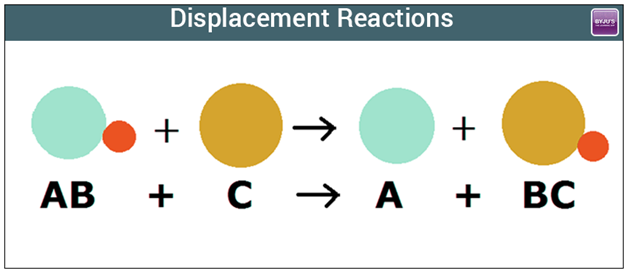
Displacement Reactions

In a displacement reaction...
a more reactive metal displaces (take over/force out) a less reactive metal.
Image result for displacement reaction
https://byjus.com/chemistry/displacement-reactions/

Exchange Reaction

Exchange reactions are where the cations and anions that were partners in the reactants they are exchange in the product.
AB+CD > AD + BC
Image result for exchange reaction


Stability Rules

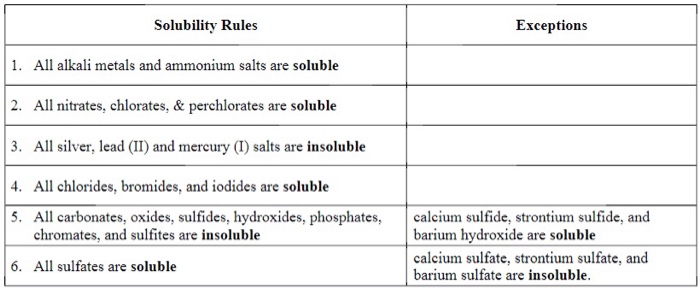
The following are the solubility rules for common ionic solids. If there two rules appear to contradict each other, the preceding rule takes precedence.
  1. Salts containing Group I elements (Li+, Na+, K+, Cs+, Rb+) are soluble . There are few exceptions to this rule. Salts containing the ammonium ion (NH4+) are also soluble. 
  2. Salts containing nitrate ion (NO3-) are generally soluble. 
  3. Salts containing Cl -, Br -, or I - are generally soluble. Important exceptions to this rule are halide salts of Ag+, Pb2+, and (Hg2)2+. Thus, AgCl, PbBr2, and Hg2Cl2 are insoluble. 
  4. Most silver salts are insoluble. AgNO3 and Ag(C2H3O2) are common soluble salts of silver; virtually all others are insoluble. 
  5. Most sulfate salts are soluble. Important exceptions to this rule include CaSO4, BaSO4, PbSO4, Ag2SO4 and SrSO4 . 
  6. Most hydroxide salts are only slightly soluble. Hydroxide salts of Group I elements are soluble. Hydroxide salts of Group II elements (Ca, Sr, and Ba) are slightly soluble. Hydroxide salts of transition metals and Al3+ are insoluble. Thus, Fe(OH)3, Al(OH)3, Co(OH)2 are not soluble. 
  7. Most sulfides of transition metals are highly insoluble, including CdS, FeS, ZnS, and Ag2S. Arsenic, antimony, bismuth, and lead sulfides are also insoluble. 
  8. Carbonates are frequently insoluble. Group II carbonates (CaCO3, SrCO3, and BaCO​3) are insoluble, as are FeCO3 and PbCO3
  9. Chromates are frequently insoluble. Examples include PbCrO4 and BaCrO4.
  10. Phosphates such as Ca3(PO4)and Ag3PO4 are frequently insoluble.
  11. Fluorides such as BaF2, MgF2, and PbF2 are frequently insoluble.

Solubility Rules Exceptions 1. All alkali metals and ammonium salts are soluble 2. All nitrates, chlorates, & perchlorates are soluble 3. All silver, lead (I) and mereury (I) salts are insoluble 4. All chlorides, bromides, and iodides are soluble 5. All carbonates, oxides, sulfides, hydroxides, phosphates, calcium sulfide, strontium sulfide, and barium hydroxide are soluble calcium sulfate, strontium sulfate, and barium sulfate are insoluble chromates, and sulfites are insoluble 6. All sulfates are soluble

Soluble = Dissolves
Insoluble = Doesn't Dissolve (solid in a solution)

Example : 
Sodium Hydroxide was reacted with silver nitrate. An exchange of ions occurred. Sodium nitrate was formed. Rule 1 says that all nitrates are soluble. This means that it won't form a solid. 
Silver Hydroxide was also formed during this exchange reaction. Rule 6 says that all hydroxides are insoluble except sodium and potassium hydroxides. Because silver hydroxide is neither a sodium or potassium hydroxide this means that silver hydroxide is insoluble. That means a solid of AgOH was formed.

Friday, 22 June 2018

Disinfectant Investigation

Aim:


I want to investigate different disinfectant concentrations can affect the growth and reproduction of micro-organisms (Bacteria).


Research

Chloroxylenol, also known as para-chloro-meta-xylenol (PCMX), is an antiseptic and disinfectant which is used for skin disinfection and cleaning surgical instruments. (https://en.wikipedia.org/wiki/Chloroxylenol)

Hypothesis


I think the more concentrated the Detol is, the more bacteria it would kill.


Variables


Independent Variable:


The variable I will be changing is the disinfectant, I will do this by adding the same amount of disinfectant to different amounts of water

I will use:

  • Full strength Dettol.
  • The manufacturer's instructions.
  • No Dettol just water.
  • Diluted Dettol

Dependent Variable

The dependent variable I will be measuring is the size of the clear zone around the Dettol disk. I will measure the diameter of the clear zone using a ruler, which then I can use the formula π x radius^2 to get the area of the clear zone, I can get the radius by halving the diameter of the clear zone.

Other Variables


Other variables that can impact the outcome of the experiments are...
  • Growing temperature - we need to grow the bacteria at the same temperature.
  • Growing medium - we need to grow the bacteria on the same medium.
  • Growing time - we need to grow the bacteria for the same amount of time.
  • Size of the disk - we need to make sure that we have the same amount of Dettol. 

Reliability

To ensure reliability, I will repeat the experiment three times.

Equipment

  • Detol
  • Vivid
  • Water
  • Filter Paper
  • Agar Plate
  • Sellotape
  • Hole Punch
  • A solution of bacteria
  • Pippete
  • Tweezers
  • Ruler

Method

  1. Gather equipment needed
  2. Punch out 4 disks of filter paper using the hole punch
  3. Using a pipette, transfer some of the bacterial solution onto the agar plate and then swirl until it covers the surface of the agar plate, then tip out the excess solution from the agar plate.
  4. Mark the agar plate into quadrants using a vivid.
  5. Label the quadrants using the vivid making sure you label the bottom so the top can't spin around. Since the bacterial solution won't move on the bottom the label will always remain the same.
  6. Make the solutions, by mixing 400ml's of water with one cap full of Dettol to make the manufacturers instructions and then by adding another 400ml's of water we created a weaker concentration.
  7. Place filter paper in each different strength of Dettol, starting with water to the weaker solution then to manufacturers instructions then to the full strength and every time you use different strengths of the Dettol shake/wash the tweezers so you don't get extra solutions onto the bacteria which then could ruin your experiment.  
  8. Label the agar plate with your name so you can identify. Once labelled seal off the agar plate with sellotape. 
  9. Incubate upside down so moister falls to the bottom at 20 degrees for 24 hours.
  10. Observer the agar plate. Use a ruler to measure the diameter of the clear zone around each disk.
  11. Repeat experiment

Results


Plate 1Plate 2Plate 3Plate 4Average
Full Strength40mm20mm15mm37mm30mm
Manufacturers Instructions15mm14mm12mm20mm15mm
Diluted Dettol15mm12mm6mm12mm11mm
Water8mm10mm4mm9mm8mm
Plate 1


Plate 2


Plate 3


Plate 4


The aim of the investigation was to see how the different concentrations of Dettol would affect the growth of bacteria. My graph shows an increasing trend. This means that as the concentration increased the clear zone increased in diameter, meaning the higher the concentration, the more bacteria it killed.


How did we figure out the percentage of the different concentration?

For full strength, we know it is 100% since we didn't add or dilute the concentration.
For water, we know it is 0% since we didn't add any Dettol.
For manufacturers instruction we added 20ml's of Dettol and 400mls of water, we figured out the percentage by using 20/420, the second number is 420 because we added 400ml's to 20ml's (400:20) so it is 20/420 which equals 5.
For the diluted manufacturer's instruction, we added 400ml to the current manufacturer's instruction, meaning there is 800ml's of water to 15ml's of Dettol (800:20) so that means we have 820mls in total liquid, so we do 20/820 to figure out the percentage of concentration which is 2.5%. 


Discussion

What happened to the bacteria?

Bacteria is a microscopic single-celled organism that has no nucleus. Bacteria have a cellular structure as seen in the left picture. The outer layer is called a capsule, this protects the bacteria/bacterium. Between the capsule and the cell membrane there is a cell wall, this protects the cell contents and keeps the structure of the cell. After the cell wall there is a cell membrane, this controls what enters and exits the cell. Philis is located around the capsule but comes out from the cell membrane, this allows the bacteria to sense around them and attach themselves to other cells. Flagellum (Tail) allows the bacteria to move around. Inside the bacteria, there is plasmid, ribosomes, cytoplasm and the DNA.

The plasmid is a part of the DNA that has no essential processes, the ribosomes are where the proteins are made, cytoplasm is the jelly fluid in the bacteria that create chemical reactions and the DNA is the genetic information for the bacteria. Bacteria reproduce through a process called "binary fission" this is where the cell replicates the DNA inside and then elongates/grows, then it starts to divide, once they divide it creates 2 daughter cells as seen in the image above. There are two ways of bacteria receiving nutrition, one is diffusion, this is where particles from a high to low concentration, just like a sponge in water. The other way is active transport, this is where the bacteria uses a pump to suck in the nutrients, they only do this when there is not as many nutrients around as seen in the image on the right.

The bacteria killed off by a chemical in the Dettol called chloroxylenol (PCMX C8H9OCl), this
chemical is found in most household cleaning items. This chemical kills the bacteria by destrupting the cell wall and stopping the functions of the enzymes (proteins or chemicals that has a function), which are used for growth, reproductions, since this is what is the basic structure every living things needs, the bacteria will be unable to continue meaning they will be killed off. In my clear zones I noticed some bacteria that weren't killed by the Dettol, this might have been because the active chemical that kills bacteria in Dettol chloroxylenol is very effective against gram positive bacteria and not against gram negative bacteria. Another possible reason for bacteria growing in the clear zone is that some of the bacteria could be resisted towards antiseptics. With this experiment, I now know that I can implement this when I am using Dettol to clean at home. Since I know that I do not require full strength Dettol to kill our everyday household bacteria, instead we can diluted the Dettol by like 400ml's for every 15ml's of Dettol used and still get the same effect as full strength Dettol since only a little bit of Dettol is needed to kill bacteria, but if we use too diluted water there will be barely any of the chemicals that killed the bacteria getting into the bacteria cell. Through a process called diffusion, the chemicals from Dettol would be able to get into the bacteria cell killing the bacteria.

Evaluation

ConcentrationPlate 1Plate 2Plate 3Plate 4Average
Full Strength 10040mm20mm24mm37mm30
Manufacturers Solution 515mm14mm12mm20mm15
Diluted Manufacturers 2.515mm12mm6mm12mm11
Water 08mm10mm4mm9mm8
I think this investigation went good. This was successful because we were able to see the clear zones of the bacteria killed. This is reliable because I collected 3 different results and came out with some reliable results. There were a couple anomalies in my data which includes in all the plate for the diluted manufacturers solution there is a 15 mm, 12 mm, and 6 mm, this might be because of us forgetting to clean the tweezers or us mixing around the solutions. For the water solution there shouldn't be a single bacteria killed but there is some, this might be because since there is chlorine in our water system, that might be killed our bacteria. This means that if we want to repeat this experiment we might need to used distilled water (boiled or bottled) and remembering to clean the tweezers. I wasn't able to calculate the areas of the bacteria killed since the bacteria that was growing in the clear zone and that the circles were perfectly rounded.